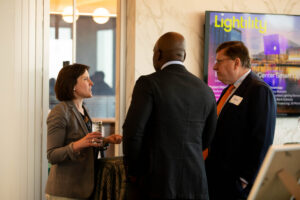
As part of the 2026 DC Climate Week, the Building Innovation Hub and the Montgomery County Green Bank co-hosted a networking event bringing together over 70 industry leaders in the Washington, DC metropolitan area for a rooftop reception at the Daikin Sustainability and Innovation Center. The event kicked off with an intimate panel discussion for sponsors and their guests on how to finance high-performance buildings in a constrained capital market.
Panel summary
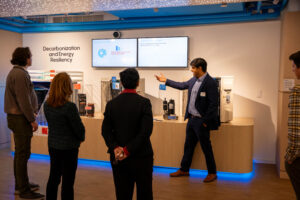
The panel highlighted the growing role of blended finance, innovative capital structures, and cross-sector partnerships in unlocking clean energy and building decarbonization projects that may otherwise struggle to move forward in today’s environment. Panelists, represented senior leadership across the capital stack—including community development financial institutions (CDFIs), mission-driven lenders, green banks, and conventional banking institutions. They shared insights on the evolving financing landscape and how the market continues to advance building decarbonization.
Panelists
- Moderator: Rokas Beresniovas, Senior Director of Commercial Business & Investments at Montgomery County Green Bank,
- Hana Freymiller, SVP | Director of Energy Project Finance at Climate First Bank
- Bill Greenleaf, Executive Director, Impact Lending at Locus Bank
- Anmol Vanamali, Chief Investment Officer at Maryland Clean Energy Center
Key Takeaways
- Capital is available and the demand for high-performance buildings remains strong. Despite tighter markets and higher interest rates, lenders still have capital to deploy for the right project. There is continued demand for financing high-performance buildings, solar, battery storage, and energy efficiency retrofits driven by higher energy prices, Building Energy Performance Standards (BEPS), and sustainability goals. The challenge is less about lack of capital and more about getting projects structured, underwritten, and finance-ready.
- The market relies on partnership-driven financing ecosystems. An example of this is the ecosystem of partnerships created through recent federal climate funding opportunities, in particular the Greenhouse Gas Reduction Fund (GGRF), has remained active and valuable continuing to support collaboration across lenders, technical assistance providers, contractors networks, and community organizations.
- Equity gaps and high interest rates are reshaping project viability. Rising borrowing costs are making many projects harder to pencil out, particularly for developers that modeled deals at lower rates in anticipation of GGRF. Borrowers may face equity gaps, limited guarantees, or difficulties accessing traditional lending. As a result, lenders are increasingly focused on creative capital stacks and risk-sharing structures.
- Technical assistance is an important aspect of financing. Many high-impact projects fail not because demand is weak, but because borrowers lack the financial statements, development expertise, or project structuring needed to access capital. Technical assistance, project development support, standardization, and education remain critical to helping building owners and developers assemble finance-ready projects and successfully navigate implementation.
- Innovative structured financing approaches such as CPACE, Energy Savings Agreements, credit enhancement tools, and off-balance-sheet financing are important mechanisms for reducing risk and enabling project deployment.
The conversation reinforced that successful building decarbonization requires more than capital alone and depends heavily on strong partnerships, coordinated support systems, and accessible financing pathways.
Thank you to our sponsors!
The event’s success wouldn’t have been possible without the generosity of our sponsors!